Quiet Cold War Inside the Gulf Part I: Models of Power
MIDDLE EAST
Philip Morande
6/5/20264 min read
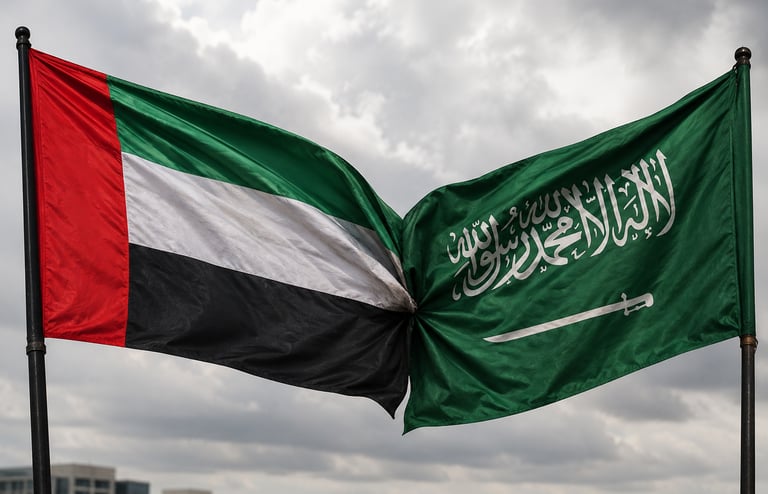
While the Gulf monarchies are often treated as a unified political bloc, Saudi Arabia and the United Arab Emirates have quietly developed different strategic cultures, military doctrines, and visions of regional influence. As the Middle East becomes increasingly fragmented and the United States encourages greater regional responsibility, these differences may become increasingly important in shaping the future balance of power in the Gulf.
Perhaps the most significant, yet least discussed, difference lies in the military sphere. Over the past two decades, the Emirates have built a reputation for operational flexibility and have demonstrated an ability to project power beyond their borders through direct intervention, special operations, and support for regional partners. Saudi Arabia, by contrast, has often struggled to translate its considerable military spending into comparable strategic results. The Saudi-led intervention in Yemen, which became a prolonged and costly conflict against the Houthis, exposed many of these limitations and raised broader questions about the kingdom's military effectiveness.
To understand this divergence, however, it is necessary to begin with geography.
Saudi Arabia and the United Arab Emirates start from very different geographical realities. Saudi Arabia covers approximately 2.15 million square kilometers, making it by far the largest country in the Gulf, while the UAE occupies roughly 84,000 square kilometers, an area almost twenty-five times smaller. The demographic contrast is also significant: Saudi Arabia has a population of approximately 38 million people, compared to around 10 million in the Emirates.
Geography alone therefore creates different strategic imperatives. Saudi Arabia must defend vast deserts, extensive coastlines, critical oil infrastructure, and multiple urban centers spread across a large territory. The Emirates, by contrast, govern a far smaller and more concentrated space, allowing resources and decision-making to be focused more efficiently.
Saudi Arabia projects weight. The Emirates project agility.
This distinction extends far beyond geography. It influences military planning, economic diversification, diplomatic behavior, and the way both states perceive their role within a changing Middle East.
These differences become particularly visible when considering modern security threats. Geography creates both vulnerabilities and advantages. Saudi Arabia must defend a much larger territory, but that same scale provides strategic depth. Major Saudi population centers such as Riyadh are located significantly farther from Iran than the principal cities of the Emirates, providing additional time to detect, track, and engage incoming missiles or drones.
The Emirates face a different reality. Their smaller territory allows for a more concentrated defensive posture and a more efficient deployment of military resources. However, geographic proximity to Iran compresses reaction times and reduces the strategic space available during a crisis. In practical terms, Emirati defenses often have less time and distance to react once a missile or drone has been launched.
Recent regional conflicts have highlighted this reality. Despite their smaller size, the Emirates have often been exposed to a disproportionately high number of missile and drone attacks compared to their Gulf neighbors. The concentration of economic infrastructure, financial centers, ports, airports, and urban development makes the country both efficient and vulnerable. Saudi Arabia benefits from strategic depth. The Emirates benefit from concentration, but pay for it with exposure.
The military contrast becomes even more apparent when examining how both states have adapted to the fragmented conflicts that have emerged across the region. The Emirates invested heavily in special operations, counterinsurgency capabilities, expeditionary warfare, and partnerships with local actors. Saudi Arabia traditionally relied on scale, conventional military structures, and deterrence. As a result, Abu Dhabi has often appeared more comfortable operating inside complex proxy conflicts, while Riyadh has struggled to achieve decisive outcomes despite possessing greater resources.
Yet Emirati success should not be overstated. The ability to influence fragmented conflicts is not the same as the ability to confront a major regional power directly. A military structure optimized for counterinsurgency, expeditionary operations, and regional influence faces very different challenges when confronted by a state possessing strategic depth, missile capabilities, industrial military infrastructure, and extensive regional networks. The Gulf states have demonstrated that they can project influence far beyond their borders; whether they can independently deter a power such as Iran remains a separate question.
Economic structures further reinforce these differences. Saudi Arabia remains heavily dependent on oil revenues despite the ambitious reforms associated with Vision 2030. The Emirates, while still benefiting from hydrocarbons, have pursued a broader diversification strategy over several decades. Dubai emerged as a regional hub for finance, logistics, aviation, tourism, real estate, and trade, while Abu Dhabi invested heavily in sovereign wealth funds, technology, infrastructure, and global financial assets.
The UAE's decision to leave OPEC represents perhaps the clearest expression of this growing divergence. For decades, OPEC symbolized the Gulf's collective influence over global energy markets. By choosing a more independent path, the Emirates signaled that their long-term strategic priorities increasingly extend beyond oil production and traditional regional coordination. Whether this decision ultimately reshapes Gulf politics remains uncertain, but it reflects a broader reality: the Emirates are no longer defining their future exclusively through hydrocarbons.
In this sense, the competition between Saudi Arabia and the Emirates is not simply a rivalry between two states. It is also a competition between two different models of adaptation to a changing Middle East. One relies on scale, resources, demographic weight, and traditional regional leadership. The other relies on flexibility, diversification, global connectivity, and the ability to transform a small state into a regional and international network hub.
The growing divergence between Saudi Arabia and the Emirates reflects a broader transformation taking place across the Middle East. As external powers reduce their direct involvement and regional actors assume greater responsibility for their own security, differences in strategy, doctrine, and national priorities become increasingly visible.
This is not a conventional Cold War, nor is it an open confrontation. It is a quiet competition between allies. Yet it may prove highly consequential. Beneath the surface of regional cooperation, two competing models of power are emerging in the post-American Middle East: one built on scale, strategic depth, and traditional regional leadership; the other on agility, diversification, and global connectivity. Understanding that competition may be essential for understanding not only the future of the Gulf, but also the broader regionalization of international politics itself. The consequences of this rivalry are no longer confined to the Arabian Peninsula. As both states seek influence beyond their borders, their competing visions of power are increasingly shaping events across the Red Sea and the Horn of Africa. It is there, far from Riyadh and Abu Dhabi, that the next chapter of this quiet Cold War is already being written
Geopolitical Labs publishes independent essays on international politics, strategic geography, and long-term global change. Subscribe to receive a simple notification whenever a new column is published. No spam. No advertising. Just new ideas.
Insights
Explore concise geopolitical analysis here.
Connect, write, inquiries
info@labsgeo.com
© 2025-2026. All rights reserved.
Geopolitical Labs publishes independent essays on international politics, strategic geography, and long-term global change. Subscribe to receive a simple notification whenever a new column is published. No spam. No advertising. Just new ideas.